5 Tips for Writing Job Descriptions That Attract Top Talent
Learn 5 proven tips for writing job descriptions that attract top talent and optimize for AI resume screening. From compelling titles to growth benefits.
Writing a job description that attracts the right candidates is both an art and a science. Your job description is often the first real interaction a candidate has with your company — and it determines whether top talent applies or scrolls past.
Why Job Descriptions Matter More Than You Think
A well-crafted job description does more than list requirements. It sells the role, filters unqualified applicants, sets expectations, and even impacts your employer brand. Research shows that detailed, clearly written job descriptions receive 2-3x more qualified applicants than vague ones. Yet most companies rush through them, recycling the same generic template for every role.
The Anatomy of a Perfect Job Description
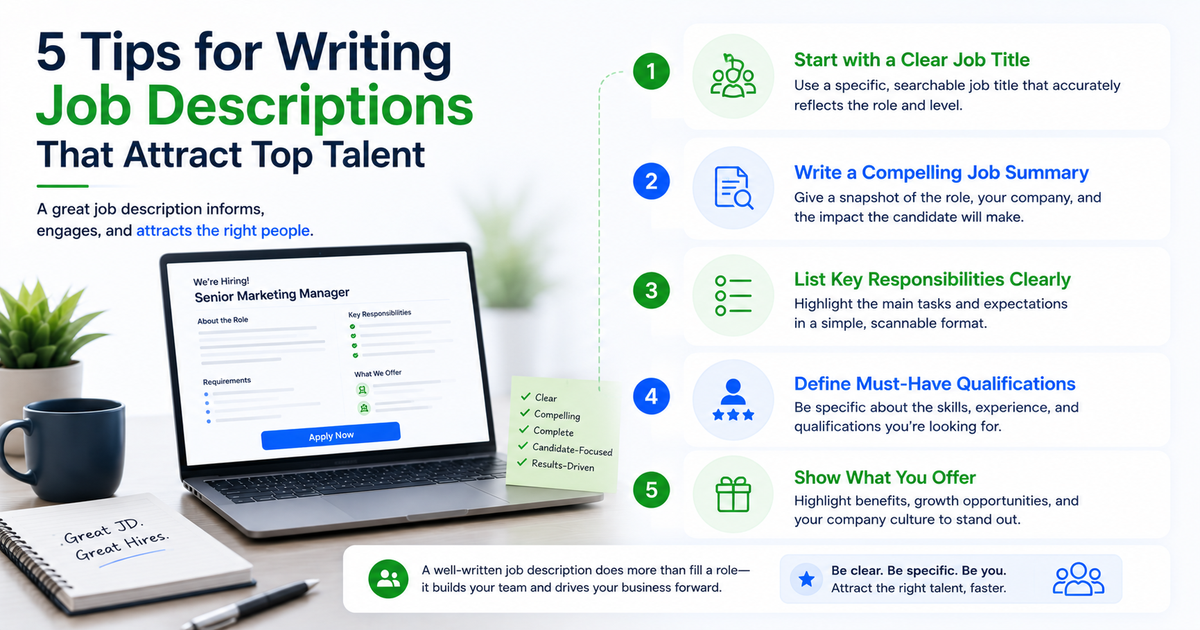
1. Start with a Compelling Title
Use titles candidates actually search for. "Senior Full-Stack Developer" beats "Code Ninja Level III" every time — your ideal candidate searched for the first, not the second. Include the seniority level, primary skill, and role type. If the role is remote, add "(Remote)" to the title immediately — it's the #1 filter for modern job seekers.
2. Write a Punchy Opening
The first 2-3 sentences should hook the reader. Explain the role, why it matters to the organization, and what makes your company exciting to work for right now. Avoid clichés like "We're looking for a rockstar" — be specific. Example: "You'll lead our data engineering team building the real-time analytics pipeline that processes 10M+ events daily." That tells a candidate exactly what they'd do and why it matters.
3. Separate Must-Haves from Nice-to-Haves
This is the most common mistake in job descriptions. When you list 15 requirements all as "required," you scare away qualified candidates who meet 10 of them. Be honest: mark the 4-5 non-negotiable skills as "Required" and the rest as "Preferred" or "Bonus." This encourages applications from candidates who might otherwise self-select out. With CandiRank, you can mark specific skills as mandatory — if a candidate is missing any, their score is automatically capped at 50, ensuring only truly qualified candidates advance.
4. Describe the Day-to-Day
List 5-7 key responsibilities using action verbs: Design, Build, Lead, Analyze, Optimize, Collaborate, Implement. Each bullet should describe concrete tasks, not vague responsibilities. Instead of "Responsible for the data pipeline," write "Design and maintain real-time data pipelines processing 10TB+ daily using Apache Kafka and Spark." Specificity helps candidates visualize themselves in the role and filters out those who aren't genuinely interested.
5. Include Growth and Benefits
Top candidates have options. Mention career growth paths, learning budgets, conference attendance, mentorship opportunities, and promotion timelines. Be specific about benefits: remote flexibility, equity, health coverage, parental leave, 401k matching, and any unique perks. If you offer a professional development budget, say how much. Transparency about compensation range early in the description reduces time wasted on both sides.
Optimizing Your Job Description for AI Screening
More companies are using AI tools like CandiRank to screen resumes automatically. Here's how to write JDs that work well with AI screening:
- Be specific about technologies: List exact tools, frameworks, and platforms. "Experience with cloud platforms" is too vague — "3+ years AWS (EC2, S3, Lambda)" is AI-friendly.
- Quantify experience requirements: "5+ years Python development" is parseable and filterable. "Strong coding skills" is not.
- Use industry-standard terminology: AI models are trained on standard job descriptions. Creative titles and non-standard skill names may not match correctly.
- Mark mandatory skills explicitly: In CandiRank, you can flag specific skills as mandatory. Missing a mandatory skill caps the candidate's score at 50 — a powerful filter for critical requirements.
- Include a clear job category: Engineering, Marketing, Sales, HR, Operations — clear categorization helps AI match your JD to the right candidates.
Common Job Description Mistakes to Avoid
- Listing 20+ requirements: You'll either get no applicants or overconfident ones who don't meet half of them. Keep it to 5-7 must-haves.
- Using gender-coded language: Words like "aggressive," "dominant," and "competitive" deter female applicants. Use inclusive language like "collaborative," "growth-focused," and "impact-driven."
- Being vague about compensation: Salary range transparency increases application volume and quality. Candidates who know the range are more likely to be a good fit.
- Copy-pasting from competitors: Candidates can tell. Write original descriptions that reflect your actual culture, team, and work.
- Ignoring mobile formatting: Over 60% of job seekers browse on mobile. Keep paragraphs short, use bullet points, and lead with the most important information.
Start Writing Better Job Descriptions Today
A well-crafted job description is the foundation of a successful hire. Take the extra 30 minutes to write something specific, inclusive, and honest — and pair it with AI screening tools like CandiRank to automatically rank applicants against your criteria. Sign up free and get 10 credits to screen your first batch of candidates.
Ready to revolutionize your hiring?
Try CandiRank's AI-powered resume screening — free to start, no credit card required.
Get Started Free